
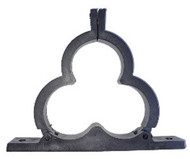
Paprsky Polymer Non-FR Trefoil Cable Cleat | PTC Series
Posted by Paprsky Energy on 8th Jun 2026
Advanced Electrodynamic Containment for Three-Phase Power Networks
In high-amperage electrical infrastructure and main distribution vaults, routing single-core cables in a three-phase configuration introduces severe physical risks. During a high-load short-circuit surge, massive electrodynamic forces build instantly, trying to violently repel the conductors from one another. If uncontained, this extreme "cable whipping" effect results in catastrophic physical destruction of adjacent switchgear, extensive downtime, and severe danger to facility personnel. The Paprsky PTC Series Polymer Trefoil Cleats deliver an unyielding mechanical containment solution. By binding three single-core cables in a rigid, triangular configuration, these high-strength clamps ensure absolute structural immobilization during normal operation and extreme short-circuit fault conditions.
Non-Magnetic Polymer Engineering and Certified Thermal Mechanics
Heavy-duty high-voltage routing requires mounting hardware that provides exceptional mechanical resistance without introducing operational electrical issues. The Paprsky PTC series is manufactured from a premium non-flame retardant Polypropylene (PP) polymer material. This advanced material composition is completely non-magnetic, which eliminates localized inductive heating and hysteresis loop losses that occur when passing heavy alternating currents through standard ferrous metal brackets.
According to rigorous ASTM and ISO testing standards, the specialized PP matrix delivers outstanding thermal and mechanical stability. It exhibits a high heat deflection temperature (HDT A) of 112°C under 1.8 MPa of stress and a mechanical melting point of 164.98°C verified by differential scanning calorimetry (DSC), guaranteeing structural integrity under elevated continuous operating conditions. To absorb severe mechanical shocks without fracturing, the polymer formula features an Izod impact strength of 39 kJ/m² at 23°C while remaining resilient down to a minimum service temperature range of -30°C to -5°C. The triple-lobed profile ensures a snug, uniform radial fit. The complete assembly is secured firmly using three mild steel zinc-passivated plated bolts, nuts, and plain washers, providing high-torque stability and excellent resistance to atmospheric corrosion.
Calibrated Sizing Matrix and Certified Short-Circuit Resilience
Engineered to protect heavy transmission networks utilizing annealed copper or aluminum conductors, the PTC series features a highly systematic dimensional profile that ensures tight, gap-free containment. To maintain strict alignment with industrial engineering specifications, the standard sizing matrix correlates exact cable cross-sectional areas with precise outer diameters, maintaining a strict 5% dimensional tolerance. For localized distribution loops, the series offers a 1Cx185 cross-sectional layout optimized for a 44mm cable outer diameter. As system capacities increase, mid-range configurations accommodate a 1Cx300 area at a 52mm outer diameter, a 1Cx400 area at a 56mm outer diameter, and a 1Cx500 area at a 58mm outer diameter. For primary utility grid transmission feeds, the series expands to a high-capacity 1Cx800 configuration matching a 60mm outer diameter, with custom size fabrication available to fit any specialized cable profile.
During certified industrial safety testing, this heavy-duty polymer architecture demonstrated extraordinary containment capabilities. The clamp successfully withstood a massive peak short-circuit current of 125.4 kA and a root-mean-square (RMS) current of 50.6 kA for a full 1.00-second duration, exhibiting absolutely no structural abnormalities, material deformation, or hardware displacement.
Streamlining High-Voltage Cable Safety Workflows
-
Massive Short-Circuit Resistance: Withstands extreme electrodynamic fault forces up to 125.4 kA peak, eliminating destructive cable whipping risks.
-
Non-Magnetic Polypropylene Chassis: Advanced PP construction completely prevents localized inductive heating and magnetic loop losses on high-amperage AC systems.
-
High Thermal and Impact Stability: Features a 112°C heat deflection threshold, a 164.98°C melting point, and a highly resilient 39 kJ/m² impact rating.
-
Zinc-Passivated Triple-Bolt System: Utilizes three treated mild steel hardware sets to ensure uniform torque retention and long-term rust prevention.
-
Tailored Geometric Fit: Perfectly surrounds single-core cable outer diameters from 44mm to 60mm within a precise 5% dimensional tolerance.
Target Applications Across Heavy Infrastructure Sectors
-
Electrical Substation Environments: Binding and restraining primary single-core transmission lines leading into high-voltage transformers.
-
Industrial Manufacturing Power Vaults: Securing heavy copper and aluminum distribution feeds along overhead trays, walls, or open concrete trenches.
-
Renewable Energy Infrastructure: Splicing and anchoring high-current collection wiring inside wind turbine shafts and utility-scale solar inverter pads.
-
Civil and Marine Infrastructure: Managing heavy-duty three-phase power umbilical runs safely within plant utility rooms and underground transport tunnels.
Operational Strategies for Secure Trefoil Containment
To guarantee maximum mechanical safety and ensure complete compliance with plant structural codes, technical crews must implement methodical installation protocols. Operators must arrange the three single-core cables in a uniform trefoil configuration, securing the polymer clamps at the precise, engineer-recommended spacing distances along the entire run to handle cable thermal expansion safely. When tightening the three zinc-passivated hardware bolts, technicians should utilize calibrated manual tools to distribute clamping pressure evenly across the split polymer body, preventing localized stress fractures. During routine facility maintenance windows or mandatory Lockout/Tagout (LOTO) shutdowns, technicians must perform a comprehensive physical audit of the containment hardware, verifying that all PP housings are free of debris or signs of environmental fatigue, keeping the primary power infrastructure safely anchored across the plant floor.